ACMT’s ACM70SA Vintage Limiter

The ACM70SA Vintage Limiter from Applied Computer Music Technologies is a dynamics processor designed to recreate the non-linear behaviour and program-dependent response of classic analogue limiters within a modern digital environment. Rather than functioning as a peak-catching loudness tool, the ACM70SA is intended for musically transparent gain control, making it particularly suitable for mix-bus and mastering applications.
The limiter employs a feedback-based topology, mirroring the behaviour of vintage valve limiters where gain reduction is derived from the output signal rather than the input. This design results in a smoother, more adaptive response to dynamic material, allowing transients to pass naturally while controlling sustained energy. The result is cohesive dynamic shaping without the aggressive artefacts commonly associated with digital brickwall limiting.
ACMT’s modelling includes a transformer-coupled signal path, introducing subtle harmonic complexity and low-frequency density while preserving high-frequency detail. This contributes to the plug-in’s ability to add perceived loudness and weight without compromising clarity. Gain reduction behaviour remains stable and free of modulation artefacts, even under heavier limiting conditions.
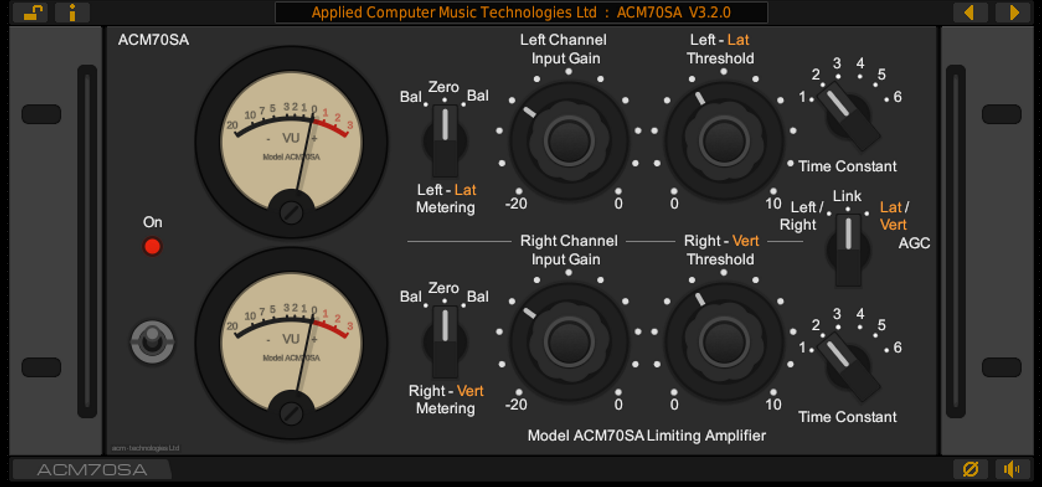
Stereo operation is highly configurable, offering linked, independent, and lateral/vertical (mid-side) processing modes. These options allow precise control over stereo dynamics, enabling engineers to maintain centre stability while managing width and ambience, or to apply independent control to left and right channels when required.
From a usability and performance standpoint, the ACM70SA features smooth, continuous parameter interpolation, eliminating zipper noise during automation or real-time adjustment. The plug-in is computationally efficient and available across multiple formats, including VST2, VST3, CLAP, and AAX, with support for both Windows and Linux systems.
In practice, the ACM70SA excels where transparent control, harmonic integrity, and analogue-style behaviour are priorities. It is best used as a tonal dynamics tool rather than a loudness maximiser, offering engineers a precise yet characterful approach to limiting in modern production and mastering workflows.
Drum Bus Weight & Control
Goal: Add body while keeping transients intact
- Mode: Independent or Linked
- Input Gain: Drive to ~2–3 dB GR
- Threshold: Lower to engage consistently
- Time Constant: Fast-to-medium
- Output Gain: Match bypass level
This approach thickens room tone and sustain without flattening attack, ideal for acoustic or live drum recordings.
Vocal Bus Smoothing
Goal: Level consistency without obvious compression
- Mode: Linked
- Input Gain: Target ~1–2 dB GR on louder phrases
- Threshold: Set for gentle engagement
- Time Constant: Medium
- Output Gain: Unity
The feedback design keeps vocal dynamics natural while reducing forward peaks and maintaining intelligibility.
Bass or Low-End Control
Goal: Stabilise low frequencies without pumping
- Input / Threshold: Aim for 1–3 dB of gain reduction
- Time Constant: Slow
- Stereo Mode: Linked
The feedback topology reacts smoothly to low-frequency energy, making it well suited for bass-heavy sources.
Mastering Control
Goal: Subtle level management with tonal enhancement
- Input / Threshold: Target 0.5–1 dB of gain reduction
- Time Constant: Slow
- Stereo Mode: Lateral/Vertical (Mid-Side)
Keeps the centre image stable while allowing controlled movement in the sides. Works best before a final true-peak limiter.