Singularity Virtual Bass

Finding a realistic, mix-ready virtual bass instrument on Linux has always been a challenge. Most commercial bass plugins ignore the platform entirely, leaving producers with limited, often outdated options. That’s why Singularity Virtual Bass stands out so strongly: it’s one of the only modern, fully featured bass instruments that runs natively on Linux and delivers professional-quality tone. For Linux-based musicians, it’s not just a good option — it’s practically the option.
Why Singularity Virtual Bass is vital for Linux users
- Native Linux support — a rare find
Many virtual instruments and amp-sim plugins simply don’t support Linux, or only work via complex workarounds. Singularity, however, officially supports Linux (glibc 2.27 or newer), giving you a native VST3 (and standalone) bass instrument you can run directly in your DAW without Wine hacks or compatibility headaches.
That alone makes it practically unique — if you want a polished, feature-rich bass virtual instrument on Linux, Singularity might be your only real option that “just works.”
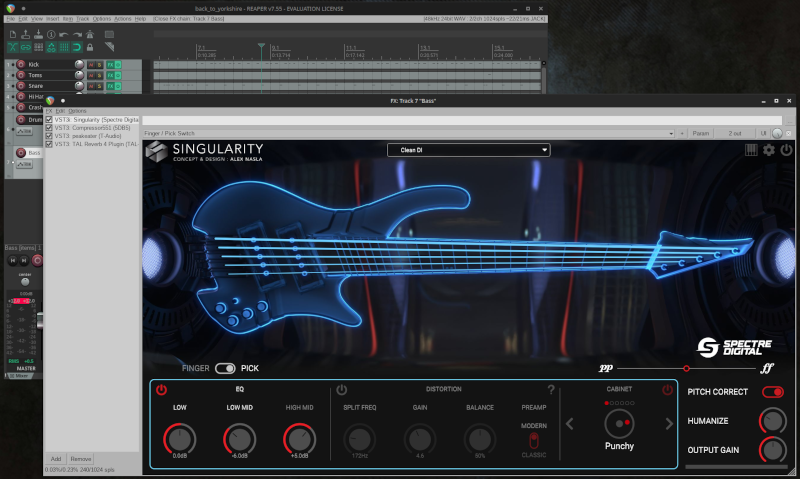
Features & Realism — Built for professional bass tracks
Singularity isn’t a barebones sample pack. It’s a fully featured bass-instrument plugin with a lot of modern conveniences:
It’s based on a carefully sampled 5-string bass (a Kiesel Precision 5-string with Jazz pickups), giving a deep, rich bass tone that spans well below standard 4-string range.
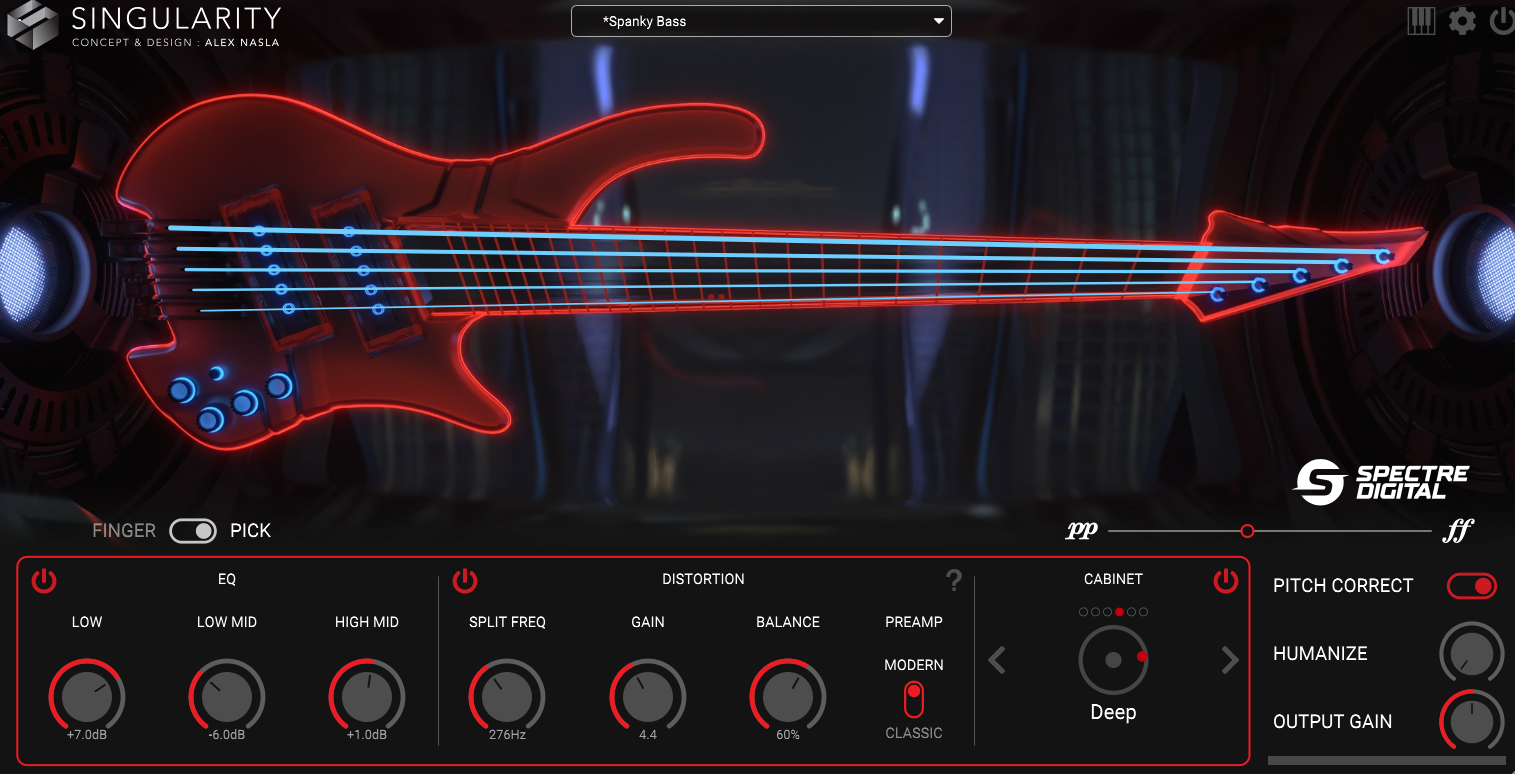
You can switch seamlessly between pick and finger-style articulation, so you’re not stuck with “one bass sound” — you get flexibility for different playing styles, genres or song sections.
Extensive articulations: slides, hammer-ons/pull-offs, ghost notes, and more realistic playing dynamics. Round-robin sampling & built-in “humanize” features avoid rigid “machine-gun” MIDI bass typical of cheap libraries.
Built-in amp-simulation + cabinet/IR processing — Singularity includes preamps (classic + modern), distortion, cab IRs, and you can even load your own IRs. So you don’t need a separate chain of plugins to get punchy rock/metal bass tone.
All this makes it far more than a generic MIDI-bass — it’s designed to replace a real bass in modern rock/metal/rock-adjacent productions.
Mix-Ready, Versatile & Efficient — Great for production flow
Singularity comes with mix-ready presets, giving you solid bass tones out-of-the-box without hours of fiddling. Whether you want clean punch, growling distortion, or classic vintage warmth — the tone control is flexible enough to serve many genres and playing styles.
Because it’s a modern plugin built for DAWs (VST3/standalone), latency and CPU load are reasonable enough for desktop Linux rigs — something you don’t always get from hacky ports or emulated instruments.
For someone producing entirely inside Linux, that means you can sketch, record, and finish tracks without needing to switch OS, use external bass players, or rely on outdated sample-bass MIDI.
What to Keep in Mind & Why There’s Still Not Much Competition
Singularity is a MIDI-bass plugin, not a real-time “record your bass guitar & simulate amp” rig. That means you don’t plug in a bass-guitar DI — you program or play bass with MIDI. So if you want the “played live” vibe, it isn’t quite the same as recording a real bass.
As a relatively new bass-VST developed with modern sampling and ML-driven modelling, some audiophile purists might still prefer a real bass or high-end hardware for subtle nuance.
The bass-plugin ecosystem on Linux remains thin. Many free or open-source alternatives are synth-based or lack deep bass-guitar realism; for many genres, they simply don’t cut it. This scarcity makes Singularity’s existence all the more valuable.
Even so — within that constrained landscape, Singularity stands out as the most complete, modern, and production-ready solution available without leaving Linux.
Who Should Use Singularity Virtual Bass
You should consider Singularity if you are:
- A Linux-based music producer / project musician / composer who wants serious bass tones without switching to Windows/macOS or using external bassists.
- Working in rock, metal, hard rock, or similarly heavy genres where tight bass tone, cab simulation, and flexibility between pick/finger style matter.
- Making demo-quality or release-ready productions on a budget — no need for multiple plugins, expensive bass, mic rig, or outboard gear.
- Doing MIDI-based composition, programming or arrangement, where you value consistent timing, easy editing, and instant tone changes without re-recording.
Conclusion — The “Go-to” Virtual Bass for Linux
In 2025, Singularity Virtual Bass represents one of the few — if not the only — modern, full-featured virtual bass instruments that works natively on Linux and delivers realistic, mix-ready bass guitar tones suitable for serious rock or metal production.
If you’re producing entirely on Linux and need a bass that sounds good, behaves realistically, and integrates cleanly into your DAW workflow — Singularity isn’t just “a possible option.” It’s probably the option.